ADA Title II deadlines explained
DOJ moved ADA Title II web deadlines to April 26, 2027 (populations of 50,000+) and April 26, 2028 (smaller and special districts). WCAG 2.1 AA still applies.
DOJ moved ADA Title II web deadlines to April 26, 2027 (populations of 50,000+) and April 26, 2028 (smaller and special districts). WCAG 2.1 AA still applies.
The ADA Title II deadline moved. On April 20, 2026, the U.S. Department of Justice pushed both web accessibility compliance dates back by one year.
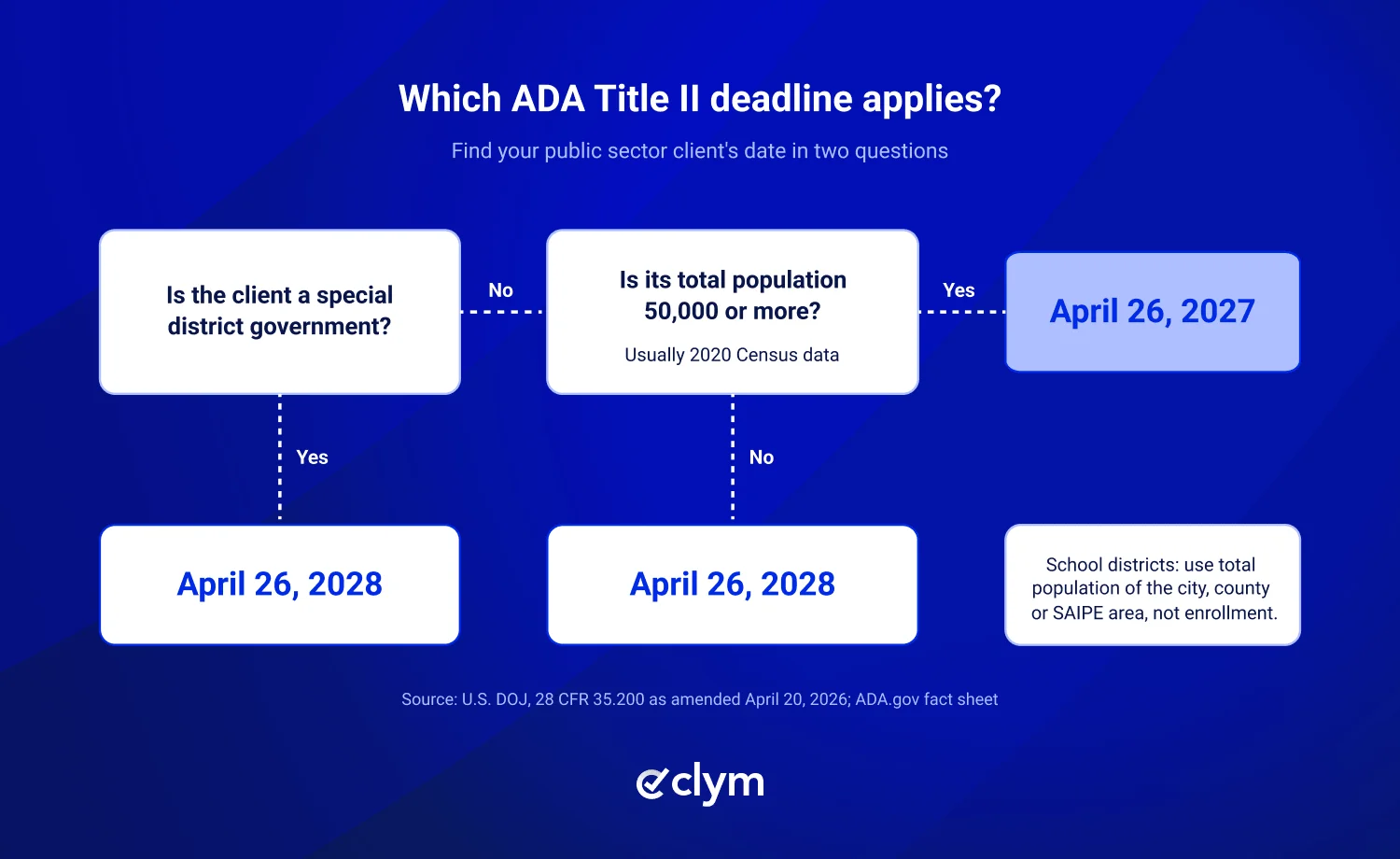
State and local governments with a total population of 50,000 or more now have until April 26, 2027. Governments with a total population below 50,000, and all special district governments, have until April 26, 2028.
The standard did not change. It is still WCAG 2.1 Level AA, and the rule still covers content that vendors build or run for public agencies.
For vendors providing websites, platforms, documents, or digital services to public agencies, these deadlines affect product development, procurement expectations, and long term service planning.
Below you will find the new deadline table, the five exceptions, and a vendor checklist you can start on this quarter.
For a deeper explanation of accessibility standards, see our guide to WCAG 2.1 and accessibility conformance. Our ADA Title II overview covers the law itself.
The DOJ Title II web rule's first WCAG 2.1 AA compliance deadline is now April 26, 2027. The DOJ interim final rule published in the Federal Register on April 20, 2026 extended both dates by one year. It took effect the same day, four days before the first deadline would have hit. Existing Title II duties concerning equal access, effective communication, and reasonable modifications continue before the new compliance dates.
Public entities with a total population of 50,000 or more must comply by April 26, 2027. Public entities under 50,000, and every special district government, must comply by April 26, 2028.
DOJ said it had "overestimated the capabilities (whether staffing or technology) of covered entities" when it set the first dates. It also said it "plans to engage in future rulemaking processes related to the substantive requirements" of the rule, so check the Federal Register for any new proposal.
These deadlines apply to digital services used to deliver government programs online, including websites, mobile applications, and many types of digital documents.
The Americans with Disabilities Act (ADA) Title II requires state and local governments to provide equal access to programs, services, and activities for people with disabilities.
In April 2024, the U.S. Department of Justice published a final rule that sets a technical standard for the websites and mobile apps state and local governments provide. The rule took effect June 24, 2024. ADA.gov keeps a plain-language fact sheet on the rule.
The rule aligns accessibility expectations with Web Content Accessibility Guidelines (WCAG) 2.1 Level AA, which address accessibility barriers related to:
These guidelines are widely used as a benchmark for accessible digital design. Organizations often evaluate accessibility conformance against these guidelines.
Your date depends on the public entity's total population. Here is the current schedule from ADA.gov.
Entity type | Original date (2024 rule) | Current deadline (2026 IFR) | Standard |
|---|---|---|---|
Public entity other than a special district government, with a total population of 50,000 or more | April 24, 2026 | April 26, 2027 | WCAG 2.1 Level AA |
Public entity other than a special district government, with a total population below 50,000 | April 26, 2027 | April 26, 2028 | WCAG 2.1 Level AA |
Special district governments (any size) | April 26, 2027 | April 26, 2028 | WCAG 2.1 Level AA |
For most governments, population comes from 2020 U.S. Census Bureau data. A city police department or library uses the population of the city that runs it.
A special district government is a public entity, other than a county, city, township or independent school district, authorized under state law to provide one or a few set functions with enough administrative and fiscal autonomy to qualify as a separate government. It also must lack a population calculated in the relevant Census or SAIPE data. Think water, fire or transit districts. A name alone does not establish the classification.
School districts are not special district governments. Use total population, not student enrollment. A city school district uses the city's population, a county school district uses the county's, and an independent school district uses its latest Census Small Area Income and Poverty Estimates figure.
Although the rule directly applies to public entities, technology vendors and contractors supporting those agencies must often meet accessibility expectations through procurement requirements and platform design.
Date | Milestone |
|---|---|
April 24, 2024 | DOJ publishes the final rule in the Federal Register |
June 24, 2024 | Rule takes effect |
April 20, 2026 | DOJ interim final rule extends both compliance dates by one year, effective immediately |
June 22, 2026 | Public comment period on the extension closes |
April 26, 2027 | Deadline for public entities with a total population of 50,000 or more |
April 26, 2028 | Deadline for public entities under 50,000 and all special district governments |
Starting preparation early allows organizations to address accessibility improvements gradually rather than attempting large-scale remediation shortly before the deadlines.
The ADA Title II rule applies to state and local government entities, including organizations such as:
- state government agencies
- counties and municipal governments
- public schools and school districts
- public universities and colleges
- courts and judicial systems
- public transportation authorities
- special district governments
Many of these organizations rely on external vendors and technology providers to design and maintain digital platforms, making accessibility an important consideration for vendor services.
The rule focuses on digital services used by public entities to deliver information and services online.
Examples include:
- government websites
- mobile applications
- online service portals
- digital documents such as PDFs and Word files
- online forms and applications
- video and audio content used for public communication
Making these digital assets accessible helps individuals who rely on assistive technologies such as screen readers or keyboard navigation interact more effectively with public services.
Some content does not have to meet WCAG 2.1 AA. The ADA.gov fact sheet lists five exceptions, and each one has strict conditions.
- Archived web content. Content created before the applicable compliance date, or reproducing paper documents or other physical media created before that date. It must be kept exclusively for reference, research, or recordkeeping, remain unchanged after archiving, and be stored in a dedicated area clearly identified as archived.
- Preexisting conventional electronic documents. PDFs, word-processing files, presentations, and spreadsheets made available before the applicable compliance date. This exception does not cover documents currently used to apply for, gain access to, or participate in government services, programs, or activities. Documents changed or revised after that date generally no longer qualify as preexisting.
- Third-party content. Posts by members of the public, such as a comment on a town message board. Content a vendor posts for the government under contract is not exempt.
- Individualized, secured conventional electronic documents. PDFs, word-processing files, presentations, or spreadsheets about a specific person, their property, or their account, protected by a password or otherwise secured. The exception does not cover the portal itself or personalized HTML content.
- Preexisting social media posts. Posts made before the government's compliance date.
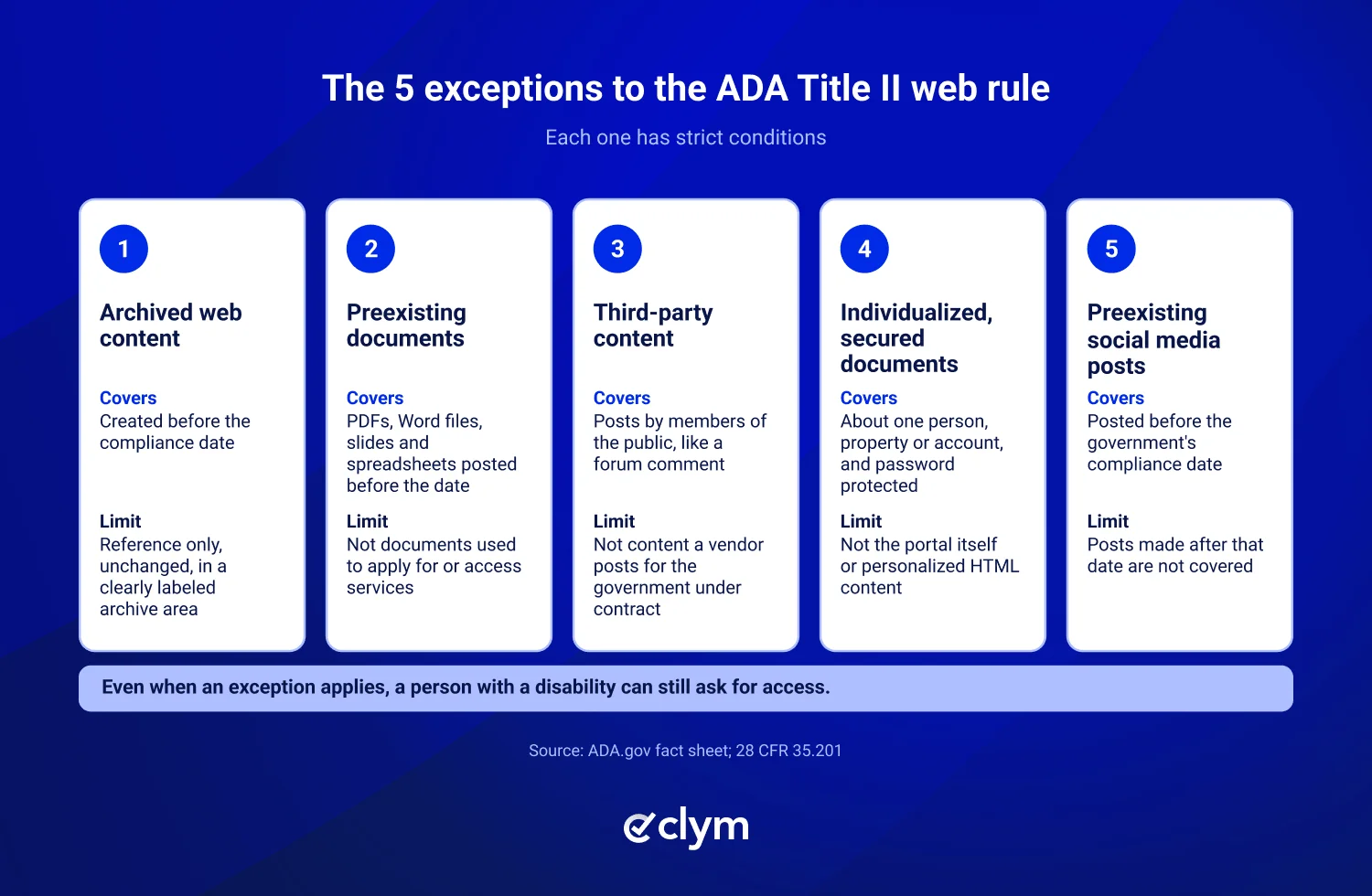
Even when an exception applies, a person with a disability can still ask for access. The government must then provide it under its existing ADA duties.
The rule also allows a few other paths. These include conforming alternate versions in narrow cases, equivalent facilitation, an undue burden or fundamental alteration defense, and a rule for noncompliance that has only a minimal impact on access (28 CFR 35.202 to 35.205). None of these is a shortcut. Plan to meet WCAG 2.1 AA.
Some claims still appear on pages written before the April 2026 extension.
Myth: The first deadline is still April 24, 2026.
Fact: The DOJ published an interim final rule on April 20, 2026 that extended both dates by one year. Public entities with a total population of 50,000 or more must comply by April 26, 2027. Entities with a total population below 50,000, and all special district governments, must comply by April 26, 2028. See the Federal Register notice and the fact sheet on ADA.gov.
Myth: An accessibility overlay or widget makes a government site Title II compliant.
Fact: The rule requires web content and mobile apps to meet WCAG 2.1 Level AA (28 CFR 35.200). ADA.gov states that automated checkers and overlays can help, but a clean report does not mean the site is fully accessible. Organizations still need to fix the underlying pages, forms, PDFs, and apps.
Myth: Vendors sit outside the rule because Title II only names public entities.
Fact: The rule covers content a public entity provides "directly or through contractual, licensing, or other arrangements." If an agency contracts with a vendor to deliver a public service, that service is in scope for the agency, and accessibility expectations often appear in procurement.
Myth: The one-year extension means organizations can pause, or that WCAG 2.2 is now required.
Fact: The extension changed the calendar only. DOJ said the substantive requirements still bind covered entities, and the technical standard is still WCAG 2.1 Level AA.
The rule references WCAG 2.1 Level AA, a set of accessibility guidelines developed by the World Wide Web Consortium.
WCAG 2.1 Level AA requires meeting the Level A and Level AA success criteria and WCAG's conformance requirements, including requirements covering complete pages and complete processes. Level AAA conformance is not required. The rule incorporates the June 5, 2018 WCAG 2.1 Recommendation (https://www.w3.org/TR/2018/REC-WCAG21-20180605/). WCAG is built around four principles.
Perceivable: Information and interface components must be presented in ways users can perceive.
In practice, images have text alternatives, videos have captions, and text has enough contrast to read.
Operable: Interfaces must be usable with different input methods, including keyboards and assistive technologies.
In practice, someone can reach every link, menu and form field with a keyboard alone.
Understandable: Navigation and content should be predictable and clearly structured.
In practice, form fields have labels and error messages explain what went wrong.
Robust: Digital content should remain compatible with assistive technologies.
In practice, the code works with screen readers and other tools people use.
Although newer WCAG versions exist, the ADA Title II rule specifically references WCAG 2.1 Level AA.
The 2026 extension did not change that.
While the rule directly applies to public sector entities, vendors providing websites, software platforms, and digital services to government agencies are often expected to support accessibility requirements.
The rule applies directly to public entities and includes the web content and mobile apps they provide through vendors. Vendors may therefore need to meet accessibility requirements through their government clients' contracts and procurement terms. That language is in 28 CFR 35.200(a). Supplying a government client does not, by itself, turn a private vendor into a Title II public entity.
Accessibility expectations may appear in procurement requirements and vendor contracts, including expectations such as:
- accessibility testing documentation
- WCAG aligned design and development practices
- accessible digital documents and forms
- accessibility issue reporting mechanisms
The extra year changes the calendar, not the expectation. DOJ says that no matter the deadline, the rule's substantive requirements bind covered entities.
Preparing early allows vendors to support public sector clients as the compliance deadlines approach.
Organizations providing digital services to government agencies can prepare through several practical steps.
- Conduct accessibility audits and accessibility remediation planning: Perform automated and manual accessibility testing to identify barriers affecting assistive technologies.
- Inventory digital assets: Review websites, applications, documents, forms, and multimedia used in public services.
- Prioritize critical services: Focus first on digital services that citizens rely on most, such as service portals, licensing systems, or payment platforms.
- Update development workflows: Ensure accessibility testing becomes part of the design, development, and quality assurance process.
- Review procurement and contracts: Check each client's procurement language and vendor agreements for accessibility requirements, and keep documentation ready to show current status.
- Train internal teams: Designers, developers, and content creators should understand accessibility principles and common WCAG barriers.
Organizations providing digital services to government agencies can start with these steps:
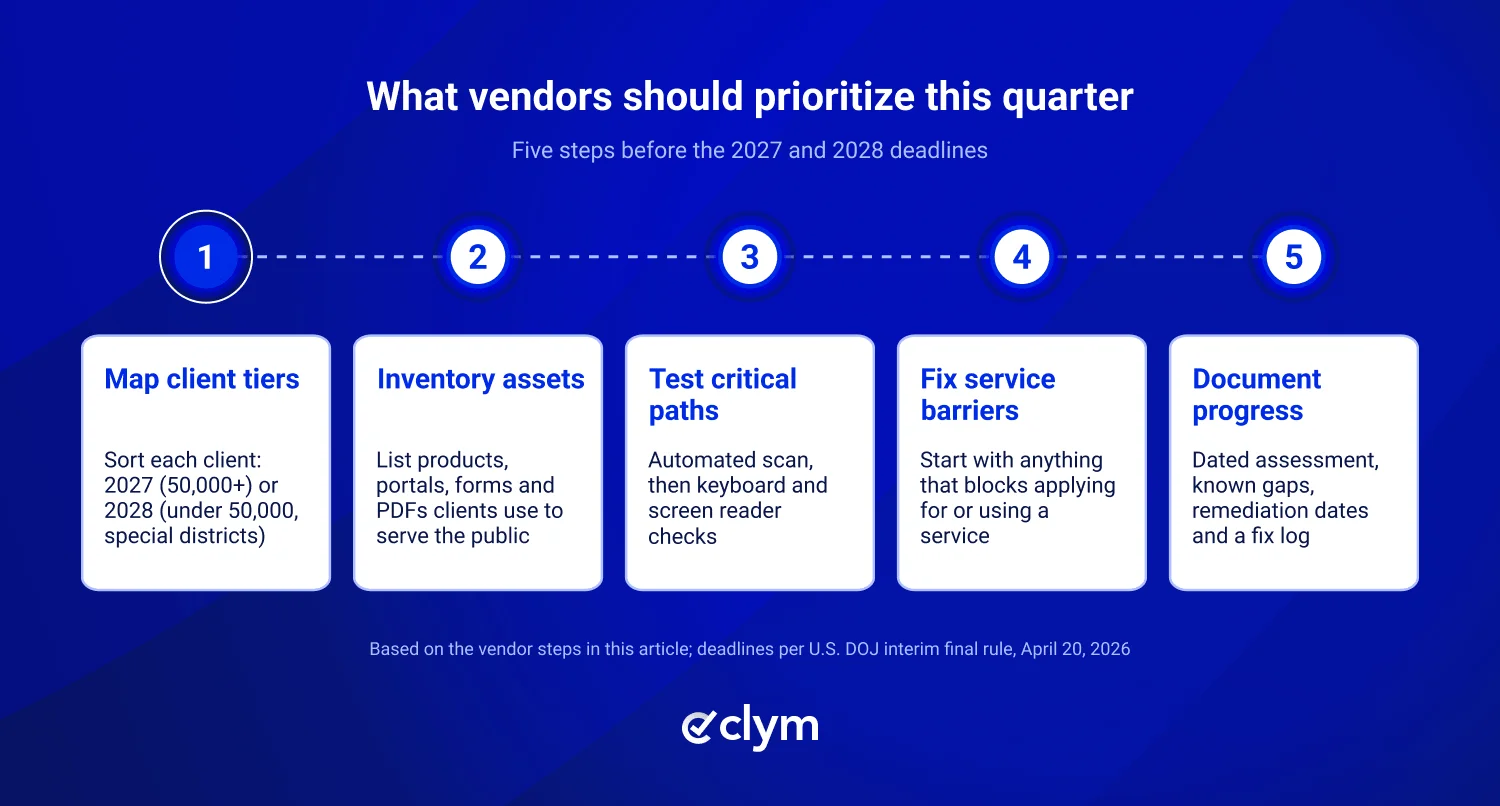
- List every public sector client and note their population tier. That tells you whether your date is April 26, 2027 or April 26, 2028.
- Map which of your products, portals, forms and documents each client uses to serve the public.
- Run an automated scan, then test the main user paths with a keyboard and a screen reader.
- Check PDFs and forms that people use to apply for, gain access to, or participate in services. The old-document exception does not cover them.
- Fix issues by severity and log what you fixed and when.
- Give clients a dated accessibility assessment showing the product and scope tested, WCAG 2.1 AA findings, known gaps, and planned remediation dates. Keep your public accessibility statement accurate, and make conformance claims only when supported by the assessment.
- Give users a way to report barriers, and track each report to a fix.
- Add accessibility checks to design reviews and release testing so new features ship compliant.
- Watch the Federal Register and ADA.gov for any DOJ proposal that changes the rule again.
Clym’s Accessibility Suite offers a streamlined toolkit to help businesses simplify WCAG 2.1 requirements and step toward WCAG 2.2 readiness:
- Accessibility Testing Suite: A free open source testing tool that helps teams evaluate websites against WCAG 2.1 success criteria, identify accessibility issues, and generate reports to support remediation efforts.
- Accessibility Scanner: Flags potential accessibility issues through automated website scans.
- Accessibility Widget: Empowers users with text adjustment, contrast modes, and navigation aids.
- Accessibility Issue Reporting Tool: Enables visitor-submitted accessibility feedback that your team can track and resolve.
- Statement Manager: Helps create, publish, and version-control accessibility statements, including managing translated versions across the website, widget, and Governance Portal.
- ReadyCompliance®: Provides preconfigured accessibility settings based on organizational profiles and applicable regional requirements.
These tools support your business's compliance efforts in preparation for the Title II deadlines, help you anticipate WCAG 2.2 expectations, and reduce manual configuration and documentation work.
For a wider view of U.S. rules, read our web accessibility compliance guide and our breakdown of 2026 web accessibility lawsuits. Our list of ten common accessibility pitfalls is a good place to start fixing.
DOJ gave public entities one more year. It did not lower the bar.
Large governments must comply by April 26, 2027, and smaller ones by April 26, 2028. Audits, fixes and contract updates take longer than most teams expect, and every new feature you ship before then adds to the list.
Bring a dated accessibility assessment that includes manual testing, a current accessibility statement, and a fix log. Review each client's procurement requirements and provide clear evidence of accessibility status.
It is a 2024 DOJ final rule that requires state and local government websites and mobile apps to meet WCAG 2.1 Level AA.
Public entities with a total population of 50,000 or more must comply by April 26, 2027. Public entities under 50,000 and all special district governments must comply by April 26, 2028. DOJ set these dates in an interim final rule on April 20, 2026.
Yes. On April 20, 2026, DOJ extended both dates by one year. The old dates were April 24, 2026 and April 26, 2027.
The rule applies to state and local government organizations, including agencies, schools, courts, and municipalities.
The rule applies to public entities, but it covers content they provide through contracts, licenses or other arrangements. So vendor-built websites, apps and portals that serve the public are in scope.
The regulation references WCAG 2.1 Level AA as the accessibility standard for digital services. The 2026 extension did not change the standard.
Yes. There are five: archived web content, preexisting conventional electronic documents, certain third-party content, individualized password-protected documents, and preexisting social media posts. Each has strict conditions.
Yes. The rule applies to both websites and mobile applications used by public sector entities.
No. The rule requires web content and mobile apps to meet WCAG 2.1 Level AA. A widget can support some users, but it does not replace remediating the underlying pages, forms, documents, and apps.

Head of Digital Marketing
Adam is the Head of Digital Marketing at Clym, where he leverages his diverse expertise in marketing to support businesses with their compliance needs and drive awareness about data privacy and web accessibility. As one of the company’s original team members, Adam has been instrumental in shaping its journey from the very beginning. When he’s not diving into marketing strategies, Adam can be found cheering on his favorite sports teams or enjoying fishing.