The DOJ's ADA Title II rule requires state and local government websites and mobile apps to meet WCAG 2.1 Level AA. Governments serving 50,000 or more people must comply by April 26, 2027, and smaller governments and special districts by April 26, 2028. Yet a July 2026 scan found about 4 in 10 big-city government websites still had at least one critical accessibility barrier.
ADA Title II Compliance for Government Websites: 2027 Deadline and What Residents Experience
Key Takeaways
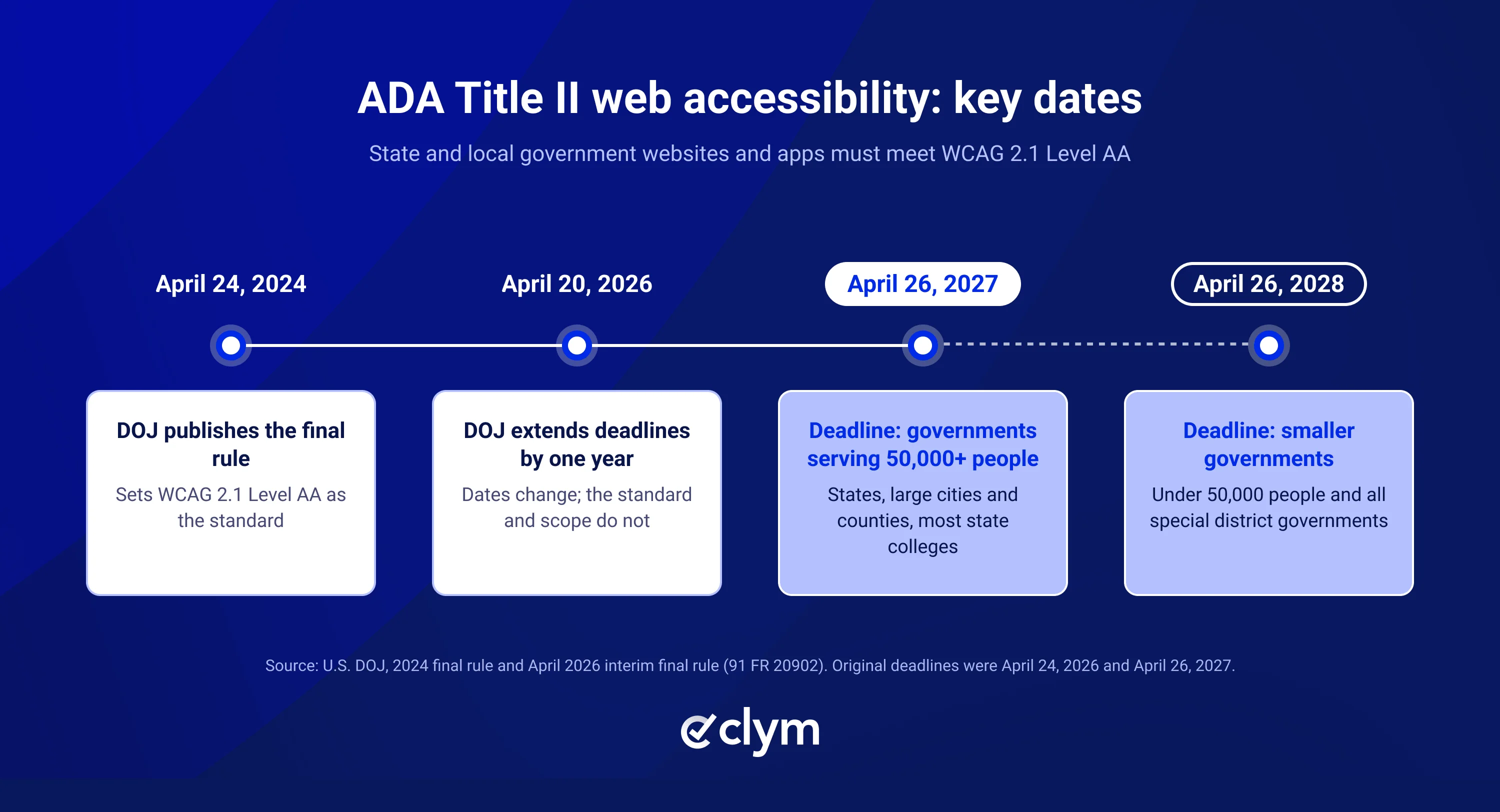
- State and local governments serving 50,000+ people must meet WCAG 2.1 Level AA by April 26, 2027; smaller governments and special districts by April 26, 2028.
- The April 2026 extension changed only the dates. The standard and the content covered stayed the same.
- A July 2026 scan of 158 large city government websites found 42% had at least one critical barrier, and 45% had buttons, links or form fields screen readers could not identify.
- Payment portals, permit forms and other tools run by vendors are covered when a government provides them, directly or through a contractor.
In April 2024, the U.S. Department of Justice issued the Final Rule on Web and Mobile Accessibility Under ADA Title II under Title II of the Americans with Disabilities Act (ADA) that directly addresses the accessibility of websites and mobile applications operated by state and local government entities.
In April 2026, the DOJ extended the compliance deadlines by one year through an interim final rule. The extension changed only the dates. The WCAG 2.1 Level AA standard and the content the rule covers stayed the same.
The rule amends the DOJ’s Title II regulations in 28 CFR Part 35 and establishes a clear, enforceable technical standard for digital services provided by public entities.
For government and municipal organizations, this rule formalizes expectations that have existed through enforcement actions and court decisions for years.
It moves digital accessibility from guidance-based interpretation into a defined regulatory framework with explicit standards and compliance deadlines.
What the DOJ’s final rule requires
The final rule confirms that digital services delivered through government websites and mobile applications are covered by ADA Title II. This includes any web-based or app-based content used to provide public programs, services, or activities.
Before this rule, public entities were expected to make digital services accessible, but there was no single, binding technical benchmark. The final rule addresses that gap by:
- Explicitly covering websites, mobile applications, and digital documents
- Adopting a uniform technical accessibility standard
- Establishing phased compliance deadlines based on population size
Key dates and compliance deadlines
Entity type | Examples | Compliance deadline | Practical risk if delayed |
|---|---|---|---|
Public entities serving 50,000+ people | State agencies; large cities; large counties | April 26, 2027 | High |
Public entities serving <50,000 people | Small towns; rural municipalities; small counties | April 26, 2028 | Moderate |
Special district governments | Transit authorities; water/utility districts; port districts | April 26, 2028 | Moderate |
Population is measured based on the jurisdiction served, not website traffic or service usage. These dates reflect the DOJ’s April 2026 extension. The original deadlines were April 24, 2026 and April 26, 2027.
Who must follow the ADA Title II website accessibility rule
The rule applies to state and local government entities, including:
- State agencies and departments
- Cities, counties, towns, and municipalities
- Public school districts, colleges, and universities
- Courts and judicial bodies
- Public hospitals and health authorities
- Transportation agencies and special districts
Coverage applies regardless of whether digital services are delivered directly by the public entity or through vendors and third-party platforms. If a website or application is provided by or on behalf of a public entity, it falls within the scope of Title II.
Accessibility standards required under the DOJ final rule
The DOJ’s final rule adopts WCAG 2.1 Level AA as the technical standard for evaluating digital accessibility, which addresses common barriers experienced by people with disabilities, including:
- Keyboard navigation and visible focus indicators
- Text alternatives for images and non-text content
- Color contrast and text readability
- Captions for prerecorded video content
- Clear labels, instructions, and error identification for forms
- Compatibility with screen readers and other assistive technologies
The standard applies to:
- Public-facing websites
- Internal web content used by government employees
- Mobile applications used to deliver public services
How accessible are city government websites today?
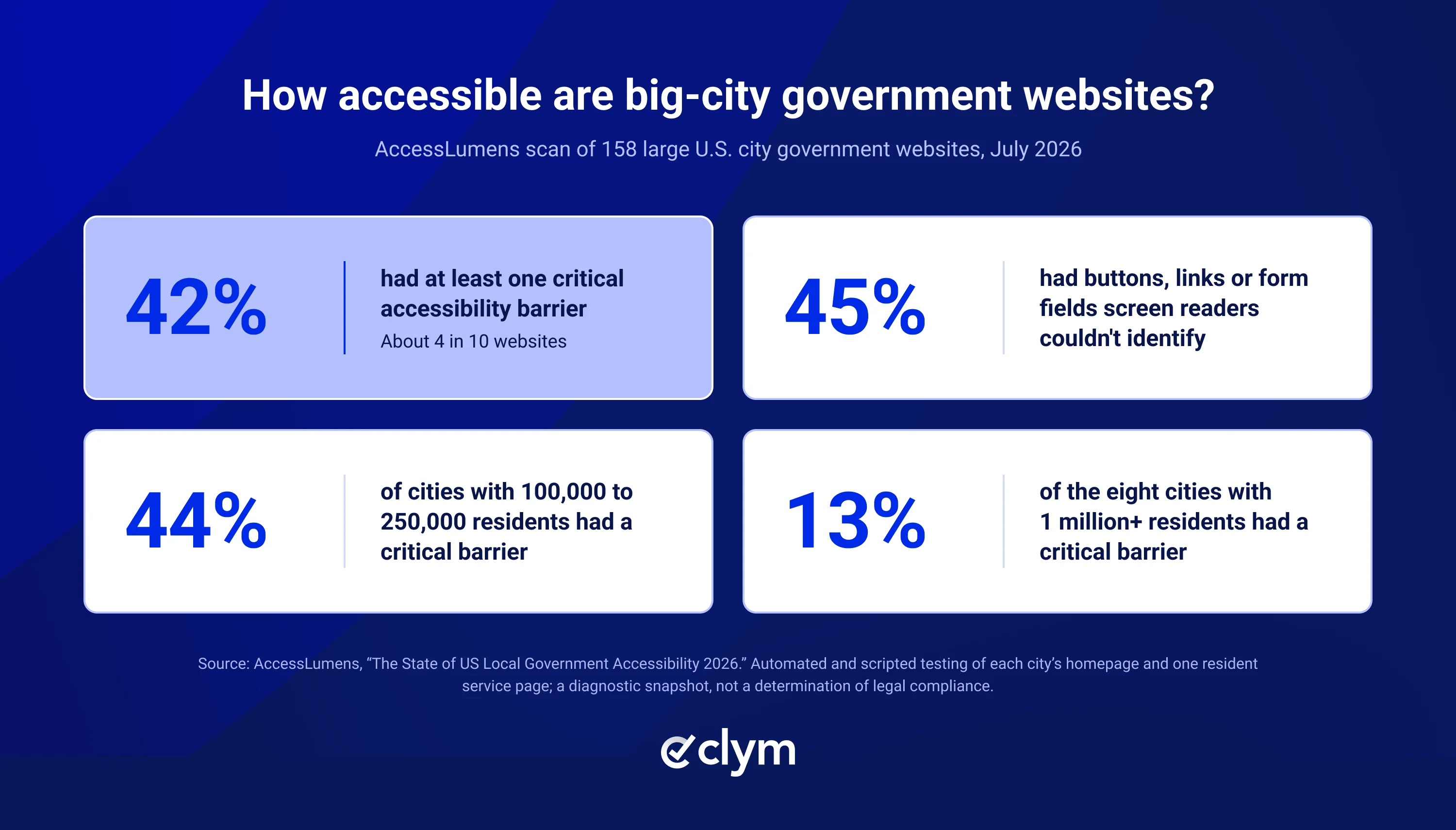
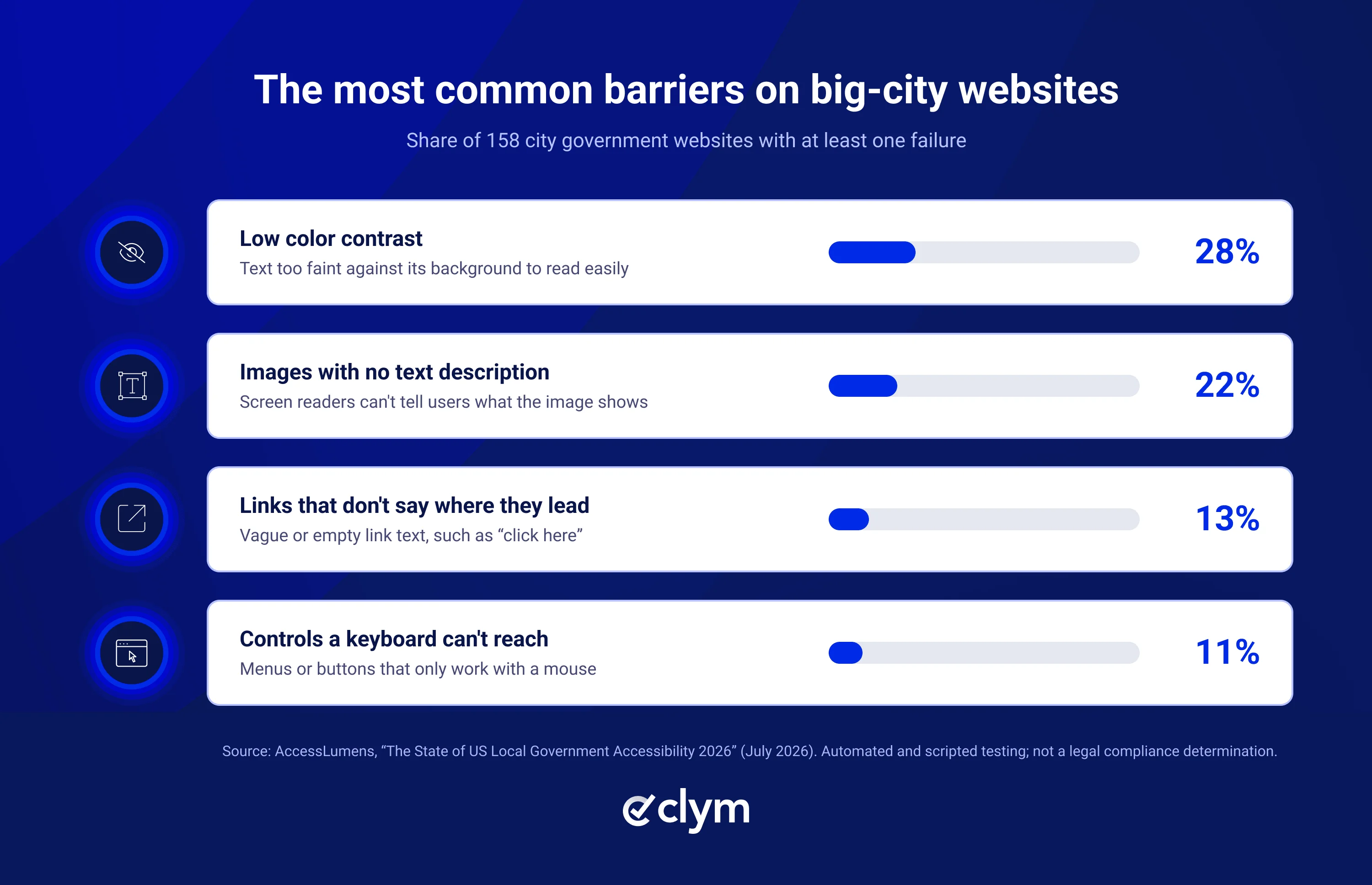
Most large city websites are close but not there yet. In a July 2026 study by AccessLumens, an accessibility testing company, 158 city government websites averaged 93 out of 100, but many still had barriers that can stop a resident using assistive technology:
- 42% had at least one critical barrier, such as a button a screen reader can't identify or a menu that can't be reached without a mouse.
- 45% failed WCAG 4.1.2 (Name, Role, Value), which requires buttons, links and form fields to announce what they are. AccessLumens says it is the criterion most often cited in accessibility lawsuits.
- Homepages were more likely to have a critical barrier than payment, permit and contact pages (34% vs. 25%).
- Cities of 100,000 to 250,000 residents had critical barriers 44% of the time, compared with 13% for the eight cities over 1 million.
The results come from automated scans and scripted keyboard tests, so they are a snapshot rather than a legal finding, and real-world barriers are likely higher. The pattern matches the wider web: WebAIM's 2026 analysis of the top 1 million home pages found detectable WCAG failures on 95.9% of them.
Why this matters for your team: a high overall score can hide a single blocking issue on the page residents need most. Testing should start with transaction pages, such as bill payment, permits, applications and contact forms, not just the homepage. Clym's Accessibility Testing and Audit combines automated scanning with guided manual review, so teams can find blocking issues on those pages and track fixes over time.
What digital content is in scope under ADA Title II
The rule applies broadly to digital content used to provide government services, including:
- Websites and subdomains
- Online service portals and dashboards
- Forms, applications, and payment systems
- PDFs, notices, reports, and public records
- Mobile applications used for public-facing services
Content is covered whether it is informational or transactional, and whether it is newly published or already in active use.
Limited exceptions
The rule includes five narrow exceptions, each with specific conditions:
- Archived web content that is kept only for reference and isn’t used to deliver current services
- Preexisting electronic documents, such as older PDFs, that aren’t currently used to access a service
- Content posted by third parties who aren’t acting on the government’s behalf
- Individualized, password-protected documents about a specific person
- Social media posts made before the compliance date
Separately, a government may decide that making specific content accessible would be an undue financial or administrative burden. That decision must be made by a senior official and documented, and the government is still expected to provide an accessible alternative where feasible. For a closer look at each exception, see our guide to ADA Title II deadlines for vendors.
Content type | Covered under ADA Title II | Example |
|---|---|---|
Websites | Yes | City homepage |
PDFs and documents | Yes, when used for services | Permit applications |
Mobile applications | Yes | Transit service app |
Third-party tools | Yes, when provided by or on behalf of the entity | Online payment portal |
Archived content | Limited, with conditions | Archived meeting minutes |
Enforcement of ADA Title II digital accessibility requirements
ADA Title II enforcement mechanisms remain unchanged. Enforcement may occur through:
- Investigations and enforcement actions by the Department of Justice
- Private lawsuits brought by individuals
- Settlement agreements and consent decrees
Outcomes often include remediation of digital content, updates to policies and workflows, and staff training requirements.
How the ADA Title II rule affects government websites in practice
For many state and local governments, websites are the primary way residents interact with public services. The DOJ’s ADA Title II final rule applies directly to these web-based touchpoints.
Below are practical examples that show how the rule affects common government website use cases:
Public university and college websites
A public university website provides access to admissions information, course catalogs, student portals, financial aid resources, and online learning tools.
Why this matters: These websites are central to how public universities deliver educational services. Under the rule, public-facing pages, student-facing portals, and web-based academic resources need to follow WCAG 2.1 Level AA so students, applicants, and staff using assistive technologies can access them.
Municipal information pages
A city website publishes council agendas, meeting minutes, and public notices as web pages or PDFs.
Why this matters: These pages are part of how the city communicates with residents. Under the rule, this content needs to follow WCAG 2.1 Level AA so residents using assistive technologies can read and navigate it.
Online forms hosted on the website
A government website offers online forms for permits, service requests, or public records submissions.
Why this matters: If form fields, labels, or error messages are not usable with a keyboard or screen reader, residents may not be able to complete required steps to access a service.
Embedded documents and PDFs
A department uploads PDFs such as applications, reports, or notices directly to its website.
Why this matters: PDFs published on government websites are considered part of the digital service. If they are not structured for assistive technologies, access to the information may be limited.
Website navigation and menus
A government website uses dropdown menus, expandable sections, or interactive navigation elements.
Why this matters: Navigation that cannot be accessed by keyboard or does not provide clear focus indicators can block residents from reaching important content.
Multimedia content on websites
A public entity posts videos on its website explaining services, programs, or emergency information.
Why this matters: Prerecorded video content typically requires captions so residents who are deaf or hard of hearing can access the information.
Third-party tools embedded on government websites
A website includes third-party widgets for payments, scheduling, maps, or service tracking.
Why this matters: Even when provided by vendors, these embedded tools are part of the government’s website experience and fall within the scope of the rule.
Preparing for the compliance deadlines
Government and municipal organizations often begin preparation by:
- Inventorying websites, portals, and mobile applications
- Identifying service-critical and high-use content
- Reviewing PDFs and legacy documents
- Evaluating third-party platforms used to deliver services
- Defining internal governance and review processes
Starting early allows remediation work to be phased and integrated into existing digital workflows.
What happens when a resident can't use your website?
For residents, a barrier usually means a task they can't finish on their own: a water bill they can't pay, a permit form that won't submit, a meeting agenda a screen reader can't read. More than 1 in 4 U.S. adults have some type of disability, according to the CDC, and older residents often run into the same problems.
Governments with 50 or more employees must already designate an ADA coordinator and adopt a grievance procedure. In practice, that means residents need an easy, visible way to report a problem, and your team needs a way to track each report to resolution.
- Publish an accessibility statement that explains your standard, known issues and how to get help.
- Give residents a simple way to report a barrier from any page, and offer an alternative way to complete the task (phone, email or in person) while it is fixed.
- Log every report, assign an owner and record the fix. That record also helps if a complaint escalates.
Clym's Accessibility Issue Reporting Tool and Statement Manager support this workflow: residents can flag a barrier from any page, and teams can publish and update their accessibility statement in one place.
How Clym can support government and municipal teams
Clym provides tools that government and municipal teams can use to support their ADA Title II digital accessibility efforts, including:
- Accessibility Testing and Audit helps teams find and prioritize accessibility issues on the pages residents rely on most, and track fixes over time.
- The Accessibility Issue Reporting Tool gives residents a simple way to flag a barrier from any page, so teams can document each report and follow it through to a fix.
- Statement Manager helps you publish and update your accessibility statement, contact details and known issues in one place.
- The Clym Scanner surfaces potential issues across public-facing pages and templates.
- The Governance Portal and Control Center centralize accessibility policies, reports and workflows across departments and domains.
These capabilities are typically used alongside internal remediation plans, procurement requirements, and legal guidance.
Frequently asked questions
Yes. In April 2026, the DOJ moved the deadlines back one year: April 26, 2027 for governments serving 50,000 or more people and April 26, 2028 for smaller governments and special districts. The WCAG 2.1 Level AA standard did not change, and the ADA's existing duty to provide accessible services still applies today.
It depends on the government the institution belongs to. Colleges that are part of a state generally fall under the 2027 date. Institutions tied to a city, county or district are measured by that government's population, and special district governments such as many transit authorities have until 2028.
Not necessarily. Automated tools catch many issues but not all, and a single blocking barrier on a payment or permit page can stop a resident even when the overall score is high. Combine automated scans with manual testing of key tasks.
Yes. The rule covers content a government provides directly or through contractual, licensing or other arrangements, so a vendor-run payment or permit portal counts as part of your website. Build WCAG 2.1 AA requirements into contracts and renewals.
Acknowledge it, offer another way to complete the task, assign the fix to an owner and record the outcome. A structured reporting channel makes this easier to manage and document.

Alex Margau
Compliance Officer

Compliance Officer | CIPP/E (IAPP) | CPACC (IAAP)
Alex is a Compliance Officer and Content Developer at Clym, where he researches and writes about everything related to data privacy and web accessibility compliance for businesses, helping them stay informed on their compliance needs and spreading awareness about making the web safer and more inclusive. When he's not writing about compliance, Alex has his nose in a book or is hiking in the great outdoors.